This sculpture standing at the Dieter-Roser-Brücke in Esslingen was created by Bernhard Heiliger. Heiliger means saint in German. So a saint created the patron saint of the bridge. The sculpture is called “Großer Fährmann”, big ferryman. Monochrome Madness
Janusz Korczak was a Polish pediatrician and educator who refused to leave the children of the Jewish orphanage where he was working when they were moved to the Warsaw ghetto. He was murdered in the Treblinka extermination camp. This sculpture to honour his memory is … Continue reading He Never Left Them
The obvious signs when looking around the garden: But in the garage, there are also signs of spring. The rollerblades are being dusted off. Back to the garden, the sign I really like to see: Henry is ignoring his indoor scratching post and is hard … Continue reading I’ll Have My Eye out for Spring
This is castle ruin Burg Hornberg above the town of Neckarzimmern. In Germany it is mostly famous for being the home of Götz von Berlichingen, the title hero of Goethe’s play. Not many people know the play but they know the name and his famous … Continue reading He Can Shove It!
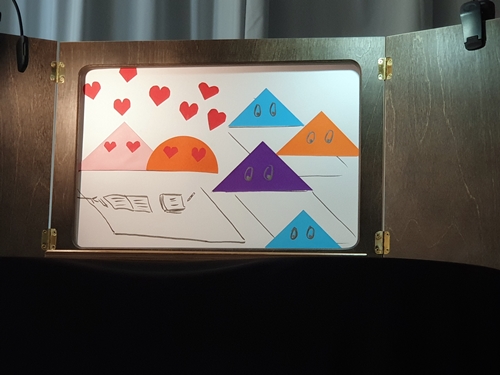
Kamishibai is a Japanese form of story telling with pictures. It translates literally as “paper play”. It was popular in Japan before and during world war II until the advent of television. Today it has resurfaced as an education method in nursery and primary schools. Although the actual pictures and narration can easily be created as power point presentations, the interaction with the audience and the intimacy of a life performance creates an almost magical atmosphere.
I spent a couple of days last week at a training workshop about narration techniques where I learned how to incorporate kamishibai into alphabetisation classes. The final afternoon was spent on creating kamishibai stories in small groups. The photo above is our final picture of the story of Quadro who goes to school where he falls in love with Ronda.






 pictures imperfect blog