(Eat your heart out, Mark Twain!) This post is for all those who at one time or another have made fun of German and its ability to form seemingly endless compound nouns, e.g. Verkehrswegeplanungsbeschleunigungsgesetz or Gleichgewichtsdichtegradientenzentrifugation. In fact, the ability to create compound nouns can … Continue reading The Genius of the German Language
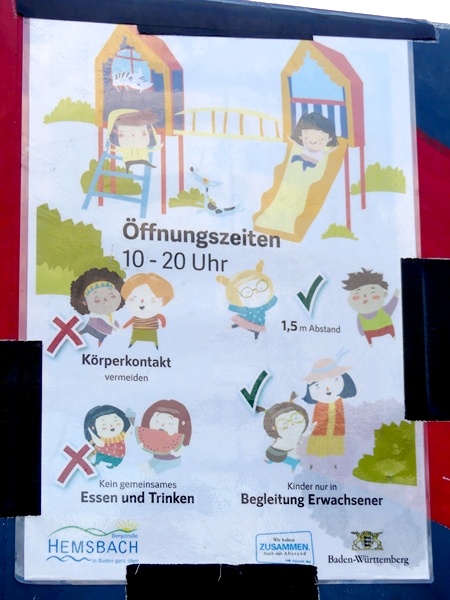
Not so long ago these posters appeared at the playgrounds in the neighbourhood and we had to abide by the rules. In truth, it was already an improvement to the complete closure of playgrounds because of the pandemic. The playground was open from 10am to 8 … Continue reading Do You Remember?
the first letters (1-3) denote the area (B = Berlin, M = Munich, RÜD = Rüdesheim, i.e. the less letters the bigger the town)
the next one or two letters are random
as are the numbers at the back (four maximum)
You used to take what you got but these days you can choose the middle letters and numbers. Lots of people drive around with their initials and their birthdates or -years.
But it’s much more fun if the plates make words. Sometimes German words but English is popular because the words are often shorter. Or people might not realise that they drive around with an expletive in a foreign language (particularly people in Fulda or Dieburg).
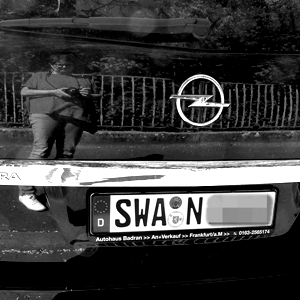
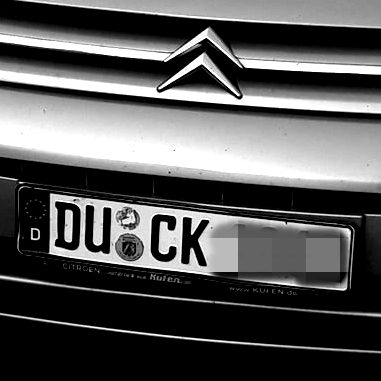
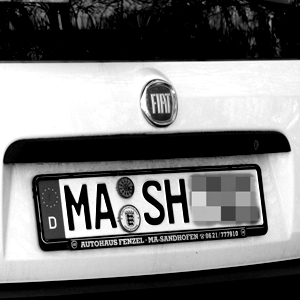
I like to collect photos of license plate words (sometimes with wonky spelling).
Street names often are handed down for generations and the actual meanings are often lost in the process. And we are left with humourous names like these: In Switzerland (found in the middle of the Odenwald, where Switzerland is far away). Dragon’s Stone (no dragon have I ever seen there). Near the house painters (formerly a street where housepainters had set up buisness, possibly). Street of the heavenly spirits (near a church, I reckon, or possibly a distillery). In the butcher (literally: inside a butcher, not a butchery). Little Hare Alley or Little Bunny Lane (I didn’t find a Big Bunny Lane in this town). Bike House Lane (a play on words: written with a T [Rathaus] it would mean town hall, but there is actually a bike shop in this road),
Warning to be towed away in Dutch – found in a German town far away from the Dutch border.
The private parking is obviously meant for … a stone trough?
Wood storage area – parking not allowed (in the middle of a German forest).
Found in the Czech Republic. I guess it means “no parking” (an online translator supports this idea – even if it insists it is Latvian). The black car either doesn’t understand or doesn’t care.
Germany is one of the most densely forested countries in Europe with about a third of the land covered by trees. During the early 1980s the term “Waldsterben” was coined in Germany. The mainstream had started to take notice of the damage that forests were taking from acid rains. I remember at the time reading a French analysis about the fact that Germans seemed to be much more disturbed than other nations about this particular ecological disaster. Germans had a much more intimate and earnest relation to trees and woods, the article maintained.
Deutscher Herbstbaum
Hence I thought it would be a good idea to start Becky’s July Squares with a very German tree: it is sporting the colours of the German flag: black, red, and gold.
Yuengling is an American beer. The founder of the brewery was of German descent and the name was originally Jüngling which means youngster in German. Obviously, the baby sees the humourof the situation.
For One Word Sunday: humour. More humourousphotos are only a clickaway.
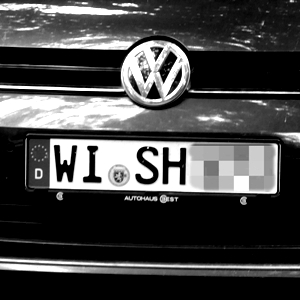
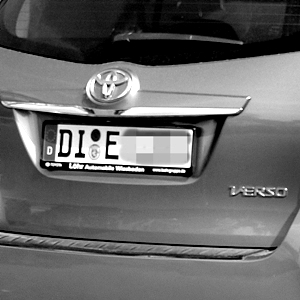
German car number plates have the area abbreviation and two more letters. In some areas one can have more fun with words than in others (try to make something pronounceable with MTK or WHV). Darmstadt (DA) is a goldmine, but Dieburg (DI) and Dortmund (DO) can also yield some interesting finds. I’ve only recently started to take pics of fun number plates, I’m sure my collection will grow in time.






 pictures imperfect blog