The Seven Swabians is a tale found in the collection of fairytales by the Brothers Grimm. Although grouped with fairytales, it is rather a droll story about seven not very bright, not very brave Swabians and their adventures – like fighting a hare which they mistake for a monster.
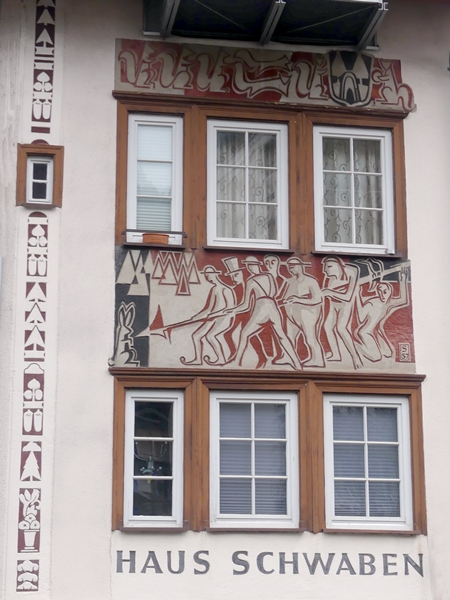
In Bad Wildbad House Swabia features a mural around some small panelled windows.
Technically not a fairy tale but rather a “funny tale”, however The Seven Swabians appeared in the collection of the Brothers Grimm. The people in the photo might not be born Swabians or even Germans some of them but they lived long enough in the Stuttgart area and identify as Stuttgarter and therefore Swabians.
This one is obvious – it’s Cinderella, of course. Cendrillon, Aschenputtel or Aschenbrödel. In the fairy tale the number of doves helping her to sort the lentils from the ashes is not clear but in this depiction (the same half-timbered house which illustrated the story of the seven little goats) there are seven doves. Seven doves for the seventh fairy tale! I have to admit to cheating again – in order to get the mural square I had to delete a panel. It only contained the prince, though.
It’s the most international of all fairy tales, with Italian and French sources, a couple of German versions, and apparently versions of this story are found in India, Arabia, Iran, and South East Asia.
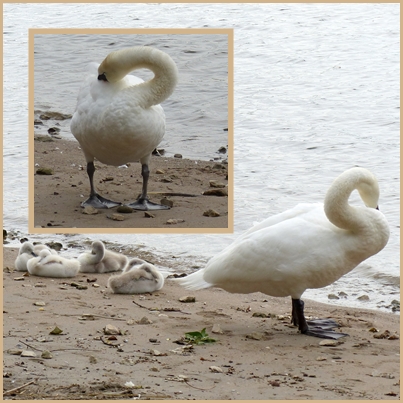
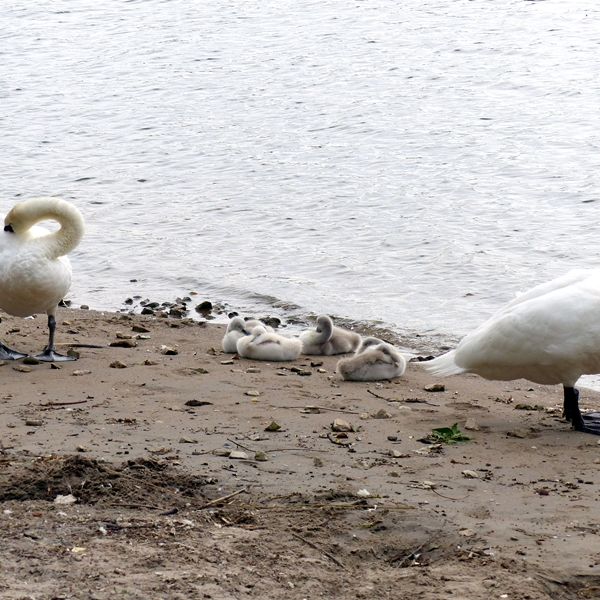
I had to cheat a bit with the photo. There are really seven swans, five cygnets and the parents, in the original photo but no way I could get them completely in a square.
Just to show that I was only cheating a little bit, here is the photo with mum and dad cut in the middle:
Another non-Grimm fairy tale. After finding Little Thumbling by Charles Perrault I started looking around and found Die sieben Schwanen (The seven swans). This tale is one retold by Ludwig Bechstein, a German Romantic who also collected fairy tales like the Grimms. The story is similar to the one about the seven ravens except that in this case the seven brothers are babies born to the Prince’s wife. Mother-in-law hates the wife and replaces the babies with dog pups. She orders the babies killed but the servant tasked with the deed lets them live. They survive, their days split between being swans and boys. The mother-in-law is decidedly cruel against her daughter-in-law, has her buried in a hole up to her neck, only gives her dog food to eat and – quite unusual – has a fountain built close by so that people who come to wash their hands dry them afterwards on the woman’s hair. The swans carry gold chains around their necks, gifts from their mother. When the bad queen hears of this she has the swans caught and collects the chains as the boys can only become human again through the chains. She orders the chains to be melted down but after she has done this with one she is discovered and buried in the self-same hole the wife of the prince is freed from. Six of the swans turn permanently into boys but the seventh swan has to stay a bird and according to the storyteller has many adventures afterwards.
This is the beginning of my mini series within Seven for September. 7 was always an important number in western cultures. It is often considered a lucky number (not so in some East Asian countries, though). It is the addition of 3 and 4 (3 in Christian culture signifying the Holy Trinity, 4 signifying the four elements: fire, earth, water, and air). According to the Hebrew bible the world was created in 7 days, we still organise our modern life in weeks of 7 days. Adding the facing sides of a die always makes 7, and we had the 7 wonders of the ancient world (the modern wonders are only a copy).
And of course, 7 is often found as a special number in fairytales. I decided to have this series directly after yesterday’s seven-year-old. Although fairy tales were not originally created for children they soon became the main audience for them.
,
Der Wolf und die sieben Geißlein
My first illustration of a Grimm fairytale is the story of The Wolf and the Seven Young Goats as depicted on a half-timbered house in Michelstadt im Odenwald which houses a toy store on the groundfloor.






 pictures imperfect blog