The poem “The Song of the Bell” by Friedrich Schiller has given a number of familiar sayings to the German language. The above one is often quoted when children or adults behave totally out of control. Some people need less provocation than others.


The poem “The Song of the Bell” by Friedrich Schiller has given a number of familiar sayings to the German language. The above one is often quoted when children or adults behave totally out of control. Some people need less provocation than others.

Because Aino asked here is a bit of information about the statues beyond the names in the tags:From left to right: Friedrich Schiller is one oft the two national poets of Germany, like Johann Wolfgang von Goethe, he lived in the 2nd half of the 18th century. Großherzog Ludwig IV. was a local regent in Hessen in the 19th century. Jran-Baptiste Kléber was the most important general of Napoleon Bonaparte, hailing from the Alsace. The severed head is an allogorical figure from the works of Friedrich Rückert, another German author, same era as Goethe and Schiller. And Großherzog Ludewig I. was an ancestor to the other “Louis” in this collage. The names are mentioned in the tags.

.
.
..

Then, Tell, since at a hundred yards thou canst Bring down the apple from the tree, thou shalt Approve they skill before me. Take they bow – Thou hast it there at hand – and make thee ready To shoot an apple from the stripling’s … Continue reading About Apples, and Snarks, and Stories

The title is a line from Friedrich Schillers drama Wilhelm Tell which is known by every German, I dare say (even if some might not know what the source is): “Durch diese hohle Gasse muss er kommen“. It’s quoted often, sometimes more or less appropriately.

The international running group of which I am part is known for its – let’s call it: creative – nicknames. A nickname has to be earned – you come to a few runs, you do something gloriously stupid, you are named. So when you first come to runs you are referred to as a “just”. Just + first name. Hence, these two would have been known as Just Johann and Just Friedrich if they had joined the HHH.
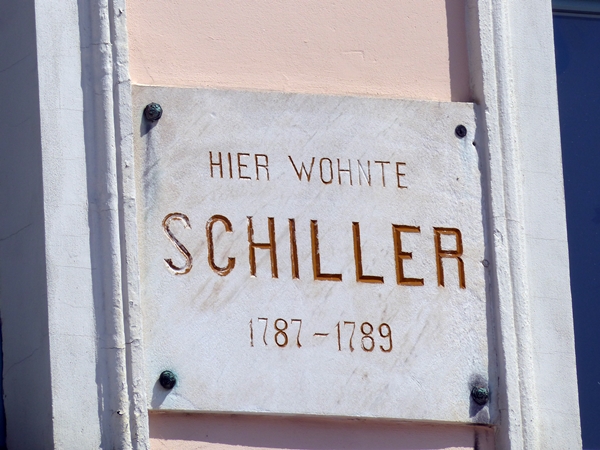
Friedrich Schiller and Johann Wolfgang von Goethe are the two poets and authors who were on the forefront of establishing the reputation of Germany as the “country of poets and thinkers”. Schiller was born in Marbach in Swabia. He fell foul of the repression of the small country of Württemberg so he fled to neighbouring Baden where he had his debut play premiered in Mannheim.
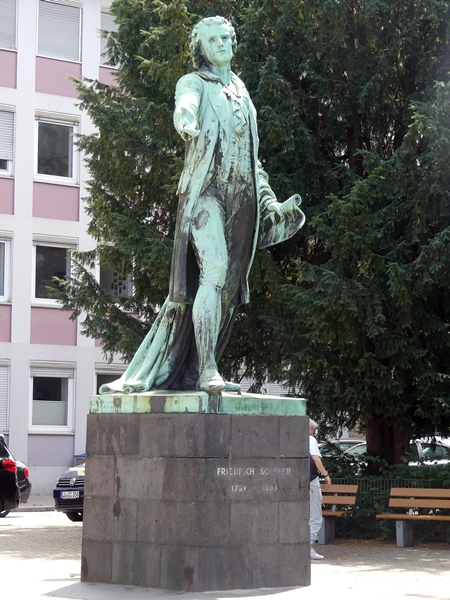
So in Mannheim I found the youngest statue of Schiller, showing him when he was about 23 – and his big success “The Robbers” premiered.
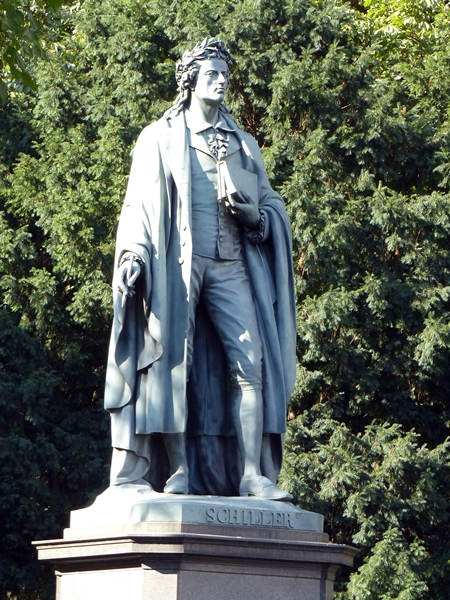
The Frankfurt statue of Schiller shows him a few years older.
He lived his last years in Weimar where his contemporary Wolfgang von Goethe was established as a politician and the reigning literature god.

Goethe supported him somewhat and the two collaborated during the years they spent together in Weimar.
He died early , only 36 years old.


 pictures imperfect blog