Tag: Johann Wolfgang von Goethe

Prometheus

Cover your heaven, Zeus,With cloudy vapours,And test your strength, like a boyBeheading thistles,On oaks and mountain peaks;Yet you must leaveMy earth alone,And my hut you did not build,And my hearth,Whose fireYou envy me. I know nothing more paltryBeneath the sun than you, gods!Meagrely you nourishYour … Continue reading Prometheus

They Are just Justs

The international running group of which I am part is known for its – let’s call it: creative – nicknames. A nickname has to be earned – you come to a few runs, you do something gloriously stupid, you are named. So when you first come to runs you are referred to as a “just”. Just + first name. Hence, these two would have been known as Just Johann and Just Friedrich if they had joined the HHH.

The Ragtag Daily Prompt: Just

I’m a Fan of … Johann Wolfgang von Goethe

Last week, I admitted to being a fan of Friedrich Schiller, today I want to show off the other half of the German poetic pair, Johann Wolfgang von Goethe.

He was a very prolific writer – he lived a long life and wrote defining works during quite a few of the literary epochs he lived through, from the Sturm und Drang (the rebellious pro-romantic youth movement), through the classic era to post-romanticism. He was also a natural scientist of renown. He studied law and worked as a minister at the court in Weimar. His literary works comprise poems, novels, essays and plays – he wrote THE definitive German play, Faust (part I and II – of which I still know parts by heart).

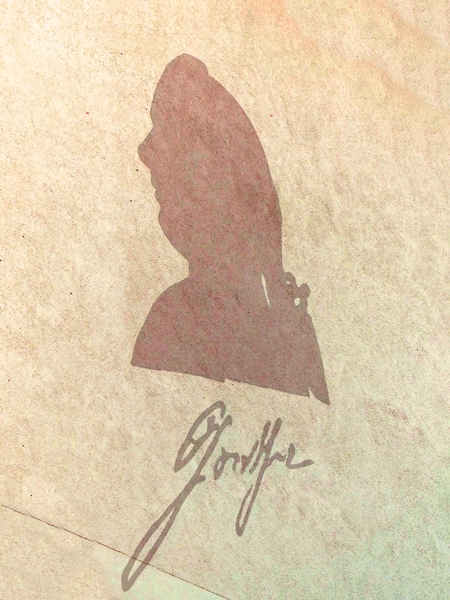
He was born in Frankfurt am Main and so it is no surprise that his face is seen in lots of places in the state of Hesse and in Frankfurt in particular.

The middle picture is not from Frankfurt but I found it in Teplice in the Czech Republic.

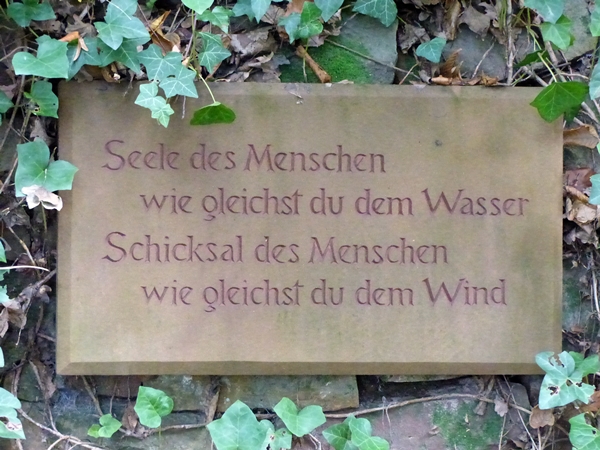
The plaque is a quote from the poem “Song of the Spirits over the Waters” and is translated as:

“Soul of man, how like to the water! Fate of man, how like to the wind!”


The mural is a quote from the novel “The Sorrows of Young Werther” and the translation reads:

“Death, where is your sting? Love, where is your victory?”

And finally a photo of the sculpture in front of the Hessisches Landesmuseum in Wiesbaden, which I found really very weird. Just look at the face of a middle-aged Goethe on top of the body a much younger man who spends his time in the gym rather than be the bon vivant which Goethe was according to all that we know.

I’d rather end this post with another view of the Goethe and Schiller, the two friends.

I’m a fan of … #164 and The Ragtag Daily Prompt: Prolific

I can be human here

In the first scenes of what is arguably the most well-known German play, Faust has contemplated suicide because he has realised his limitations in the light of his ambitions. The ringing of the church bells at the break of dawn and the Christian message of the risen Christ hold him back.

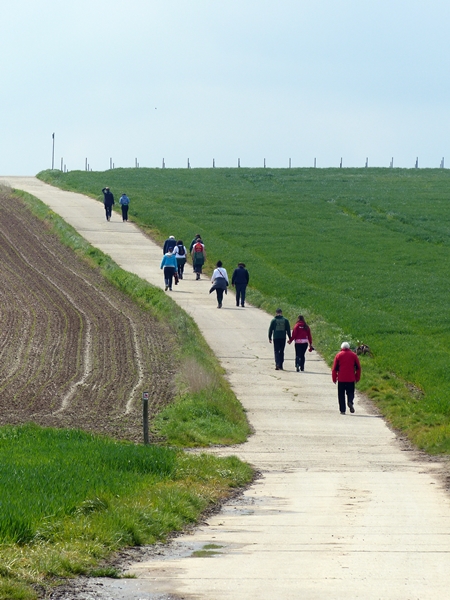
Next morning he leaves the city to join the masses of people on a stroll outside the city gates. The following is an ode to spring and humanity, a piece of poetry colloquially known as the “Easter Walk” and lines from it are known by almost every German. He starts with describing the surroundings, seeing nature freed from the white ice just as the people are freed from the grey city. Nature is still lacking colour this early in spring, so people have to supply it with their finery. The soliloquy ends with Faust’s awareness that he can join the rest of humanity.

Hence, the photo of an Easter Sunday morning stroll.

The Ragtag Daily Prompt: Human

One must ask children and birds how cherries taste

“In nature we never see anything isolated, but everything in connection with something else which is before it, beside it, under it and over it.”

Johann Wolfgang von Goethe

“Wir sehen in der Natur nie etwas als Einzelheit, sondern wir sehen alles in Verbindung mit etwas anderem, das vor ihm, neben ihm, hinter ihm, unter ihm und über ihm sich befindet.”

2024 Goethe

Linked to Travel with Intent.  For more photos inspired by this quote from Johann Wolfgang von Goethe, click here.

Goethe


I’ll say fist for the moment

These six words need an explanation.  I had a quote from Goethe’s Faust in mind (one great poet versus another one, answering Debbie’s Shakespeare) when I compiled these photos and was looking for the standard translation into English.  I entered a few keywords in the search mask including the name Faust and English and was rewarded with the above gem of the google translator.

203 faust 1

203 faust 4

203 faust 5

203 faust 2

203 faust 3

Goethe: Faust I

If ever I to the moment shall say:
Beautiful moment, do not pass away!

Werd ich zum Augenblicke sagen:
Verweile doch! du bist so schön!

The rest of the quotation is actually a denial of the perfect moment, or rather the striving for an ever more perfect one – so I’ll just ignore it for the purpose of this post.

Linked to Six Word Saturday.

A man of many talents

028 goethe 4

“Every day we should hear at least one little song, read one good poem, see one exquisite picture, and, if possible, speak a few sensible words.”

“Man soll alle Tage wenigstens ein kleines Lied hören, ein gutes Gedicht lesen, ein treffliches Gemälde sehen und, wenn es möglich zu machen wäre, einige vernünftige Worte sprechen.”

Johann Wolfgang von Goethe

Goethe

It is impossible to walk through Frankfurt and not see Goethe – he was born there  and spoke the dialect of the town (the giveaway are rhymes in some poems which only work as rhymes in this dialect).  The silhouette is on the side of a hotel in a part of Frankfurt called Bergen-Enkheim but the sculpture stands in Weimar, where Goethe and the other great German poet, Friedrich Schiller lived and for a while worked together.

Werther

In an area of Frankfurt which is a mixture of commercial and industrial buildings this quote by Goethe can be seen on the side of a house.  It is the combination of a line taken from “The sorrows of Young Werther”, which Goethe wrote when just 24 years old and which was extremely influential at the time, and the words with which he signed a letter to his wife years later (in English).  The quote is a a variation on 1 Corinthians 15; 55: “Death, where is they sting?” Werther (or rather Goethe) continues not: “Grave, where is thy victory?” but “Love, where is thy victory?  You are leaving, I’ll remain …”

Tradition Leidenschaft

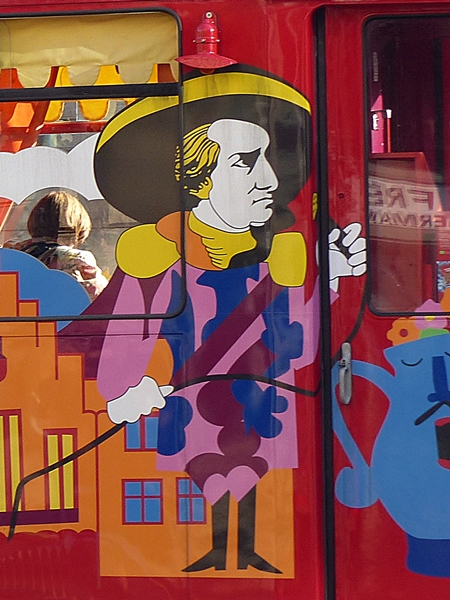
Johann Wolfgang von Goethe combined many different aspects in his life: he was a highly successful author of poems, plays, and novels, he wrote academic papers, undertook research in various fields and made a few scientific discoveries, he was a trained lawyer, a politician at the court of Sachsen-Weimar, a theatre director, a man who lived for a few years fairly openly with a lover well below his social standing before marrying her.  By all accounts, he was also a very worldly man who enjoyed food and drink. So it is only befitting that Frankfurt displays his likeness  on a special tram, the so-called Äppelwoi-Express (a tram which can be booked by groups to party and drink Frankfurt style cider while driving through the city).

This is linked to Travel with intent: one little song.