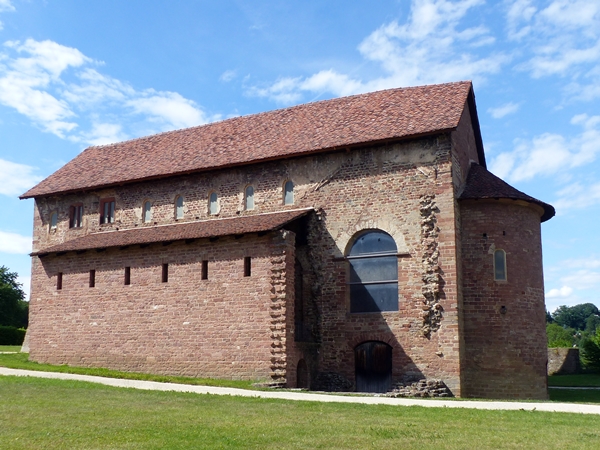
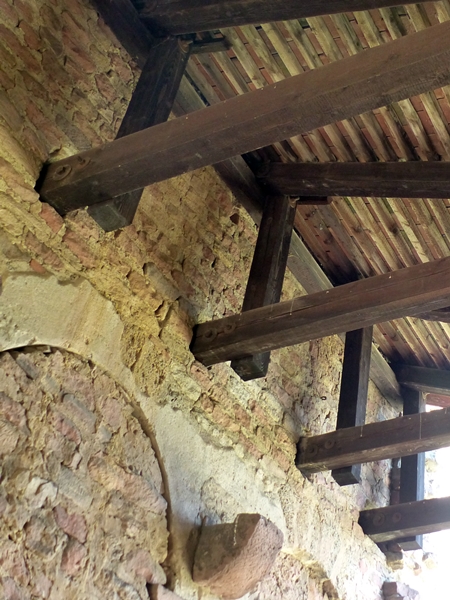
Inside the Einhard’s Basilica in Michelstadt. Built for the chronist of Charlemagne, Einhard abandoned the basilica and transferred his intended burial site to Seligenstadt (his church there housed important relics which made Seligenstadt into a pilgrimage site) thus saving the one in Steinbach from major renovations and thus preserving many of the Carolingian features.
There are not many buildings left from the Carolingian area in Germany. The most famous is the Lorsch Abbey near Worms in the Rhine Valley, a UNESCO world heritage site. The basilica of Einhard, about 40km to the east, is less well-known. This is a model on the site.
Einhard, who was amongst many other functions at the court the biographer of Charlemagne, had the basilica built in the early part of the 9th century and endowed it with relics, probably in order to make it into a centre of pilgrimage. His plans did not come to fruition and the relics were removed to Seligenstadt in the North. Other clerical buildings of the time were renovated and modernised throughout the century whereas this basilica was left mostly in its original state.
Imagine approaching this building at a time when most buildings were hardly higher than a man!
More information on the Einhard’s basilica can be found on this blog, called English Speaking Odenwald written by an American expat living in the area.
“Travel makes one modest, you see what a tiny place you occupy in the world.”
Gustave Flaubert
The quote by Flaubert is not only applicable to space but also to time. This basilica dates back to the 9th century, one of the few remnants of Carolingian architecture north of the Alps.
Linked to Travel with Intent. For more photos inspired by Flaubert’s quote, click here.
The Abbey of Lorsch is a UNESCO world heritage site, close to Worms in the Rhine Valley, about 60km south of Frankfurt. It was an important monasteries during the Carolingian times. Through one of the arches of the “kingdom hall” one can look upon the monastery’s church.
Three arches, facing north and south, lead into the main room.
There are innumerable ways to play with these arches and their vistas. This time I preferred to try out desaturation.
The coarse stones and coarser roof tiles of the “Blaue Hut”, one of the three remaining towers of the medieval town wall of Weinheim. The name comes from the slate tiles of the original roof.
Smooth clinker around the modern, gothic inspired window of the church St. Marien in Mönchengladbach-Rheydt.
Course sandstone bricks forming the base of a half-timbered house in the Odenwald.
The structured front of the Königshalle of the Lorsch Abbey built in the ninth century is the oldest monument of Carolingian architecture. It is a UNESCO world heritage site.






 pictures imperfect blog