At the southern tip of the Kruger Park is the Berg en Dal Camp and most of the white rhinos can be found in its vicinity. When we were there in the 1980s their numbers were more than three times what they are now, and even that wasn’t a glorious past for the beasts.
This much smaller armoured creature was inside one of the camps and we helped it out of the road.
In the Kruger National Park there is no hiking – the humans sit in a metal cages rolling past the animals. Even if walking was allowed the distances would make it very difficult to get around. The park itself is almost 20.000 km2 in size (that’s without the adjoining private areas the parts in Mozambique and Zimbabwe with which it forms the Great Limpopo Transfrontier Park). That’s about the size of the state of Israel and half the size of Switzerland.
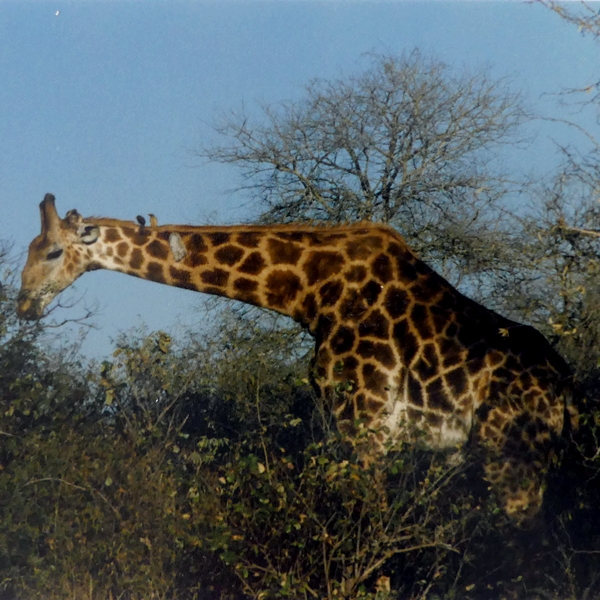
This giraffe was very obliging, ducking its head to fit in the frame.
Admittedly I’m cheating a bit here but by name the Kruger National Park in South Africa is a park.
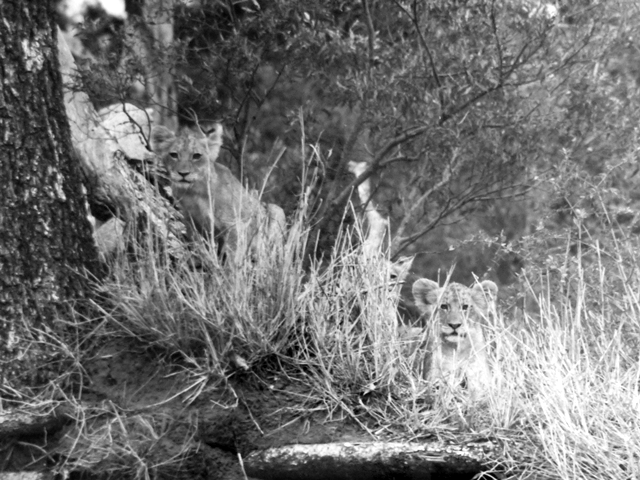
The photos are not good quality, they were taken in the early 1980s. Unfortunately, at the time I didn’t like glossy prints and the matt paper prints looked slightly fuzzy to begin with and don’t photograph too well. However, they record a very fond memory of mine, and the monochrome treatment does their age justice.
We were driving on the roads of the Kruger Park, somewhere between Skukuza and the Lower Sabie Rest Camp, when we saw a large yellow animal standing under the tree in the distance. Only when we got nearer we were realising that it was a lioness.
She stood stock-still on the side of the road. We admired her for quite a while until we had the idea to see what she was looking at. That’s when we realised that on the other side of the road were her cubs.
We were mesmerised. When we looked back at the lioness she had disappeared, obviously circumventing us. We drove off, thinking it would be better to let her get to her cubs undisturbed.





 pictures imperfect blog