Tag: Mahnmal

Don’t Tread on Them

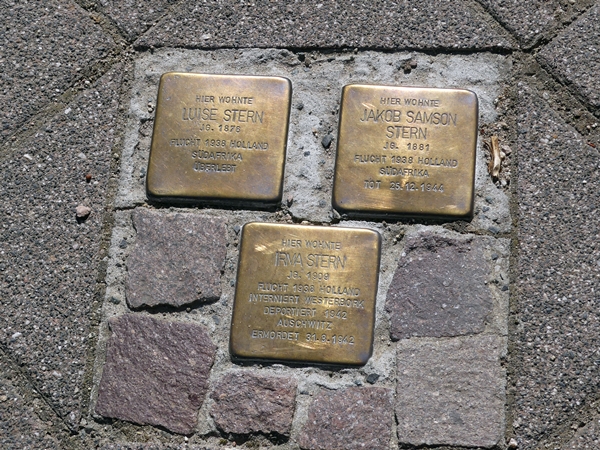
The “Stolpersteine” or “stumbling stones” are a project of the artist Gunter Demnig. They are brass covered cobblestones on pavements outside houses were Germans of Jewish descent used to live. Other persecuted groups are commemorated in this way as well. They are inscribed with their names, their dates of birth and short information what happened to them. This particular family of Luise and Jakob Stern who I found in Rüsselsheim had the parents emigrating to South Africa, where the father died before the end of the war. Their daughter Irva was murdered in Auschwitz.

More than 75,000 stones have been laid in Germany, more in neighbouring countries where the Nazi terror regime was present.

FOWC with Fandango: Poignant

……………………………………….

Remembering for the Future

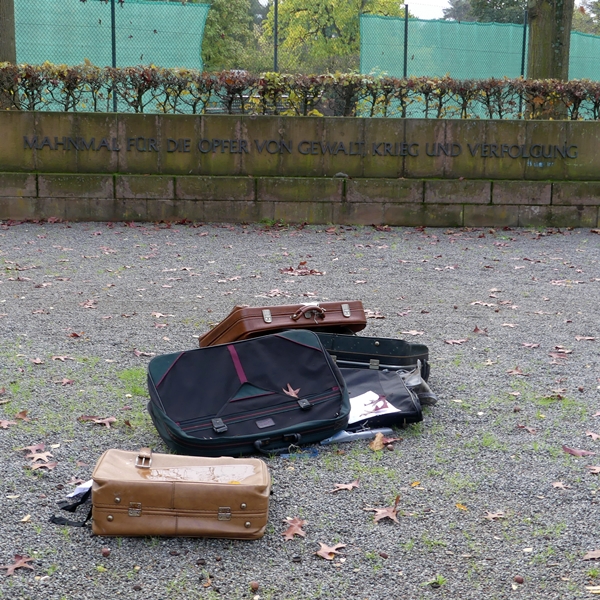
A little park, close to the botanical garden, has tennis courts in the middle and a memorial at the entrance. The memorial is for the victims of violence, war and persecution.

On 15 October 1940 the live-in patients of the local special care nursing home for people with physical or mental handicaps were moved to Grafeneck, an extermination facility. They were killed there.

On 22 October 1940 the Jewish people living in Weinheim were transported to the Camp de Gurs from where they were sent to Auschwitz-Birkenau. Where they were killed.

The synagogue used to be near the memorial. It had been destroyed almost two years earlier on 10 November 1938 during the November pogroms.

Every year from mid-October onwards a few random suitcases are placed in the middle of the star of David which is embedded in the ground of the memorial. People had but a couple of hours to pack their belongings in a suitcase, one suitcase per person, before being taken from their homes.

Walking Square #10

.

.

Life Is Not Safe

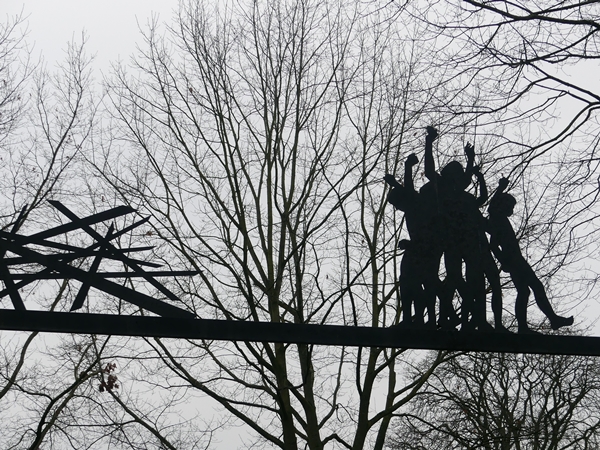
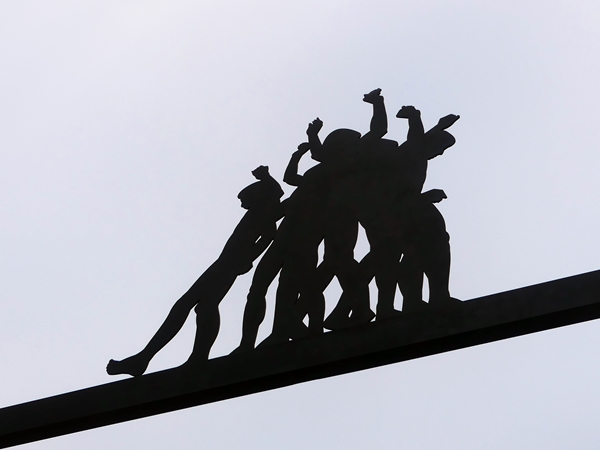
This is part of the Memorial for the victims of violence, war and persecution in Weinheim. It is considered one of only a few counter memorials in Germany opposing war monumenta. I find the war memorial on the opposite end of the street, which dates from the 1930s, very martial and in the style of the Nazi era with three soldiers in winter uniforms more like then modern day soldiers than ww I soldiers. The names of the fallen soldiers of the town from world war II were added in the 1950s.

The counter memorial was erected in 1999 and includes a statement explaining about the victims and a star of David. The group of people on the thin beam above the memorial seems without a foothold and permanently in danger of falling – illustrating the precariousness of life, particularly life in a totalitarian state.

FOWC with Fandango: Precarious

……………………………………….

there but for the grace of god

05 reflection b
“Spiegel der Geschichte” von Matthias Braun – a memorial in Schwetzingen, Germany, commemorating the victims of the Nazi era and urging future generations to safeguard democracy and human rights.

To me this installation signifies the truth that it happened to them and it can happen to us – the people reflected in the figures. The people seen clapping is an art  installation on the opposite side of the road called “Die Claque” from Guido Messer – depicting four men clapping with their eyes closed, applauding whatever they are paid to applaud.

05 reflection d

https://dailypost.wordpress.com/photo-challenges/reflecting/