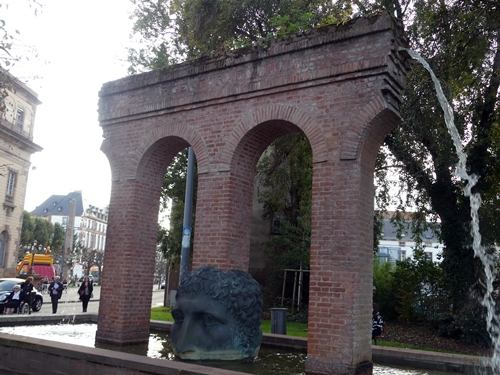
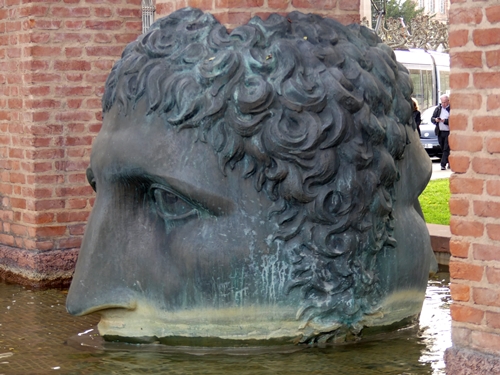
This sculpture by Tomi Ungerer, called either Aqueduct of Janus or Janus fountain (l’Aqueduc de Janus or Fontaine de Janus), signifies the double culture of Strasbourg, shaped by France and Germany in equal measure. It features a double sided Janus head looking in two directions, west and east.
was designed by Tomi Ungerer. He was a graphic artist and book illustrator, born and raised in the Alsace (a biography of him calls him an Alsatian artist which sound really odd). The fountain was to represent the duality of the Alsace with roots in France and Germany.
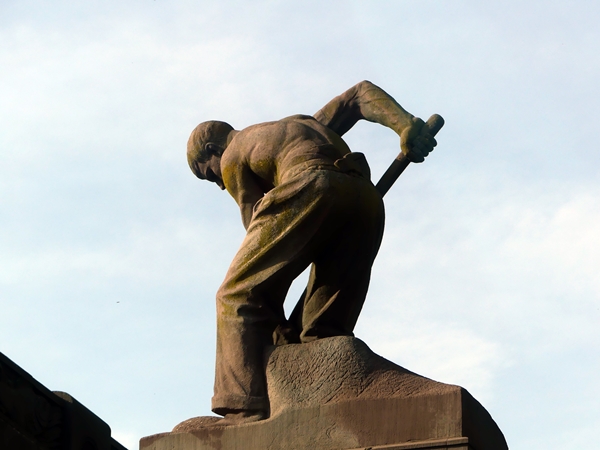
This is one of the four statues on the Pont JF Kennedy in Strasbourg, one of the bridges to cross the Ill. The statues all depict workers who do hard manual labour – this is the pelleteur. His job was to clear the waterways from the silt so it would stay navigable for bigger boats. The profession died out in the 1920s.
The bridge was built in 1906 and was then called Schwarzwaldbrücke (pont de la Forêt-Noir / Black Forest Bridge). It has undergone a few name changes, some only because of the change of languages, from German to French and back). It became Pont John F Kennedy in 1965. The locals, however, favour the name Viermännerbruck (bridge of four men, in the local Alsation dialect).
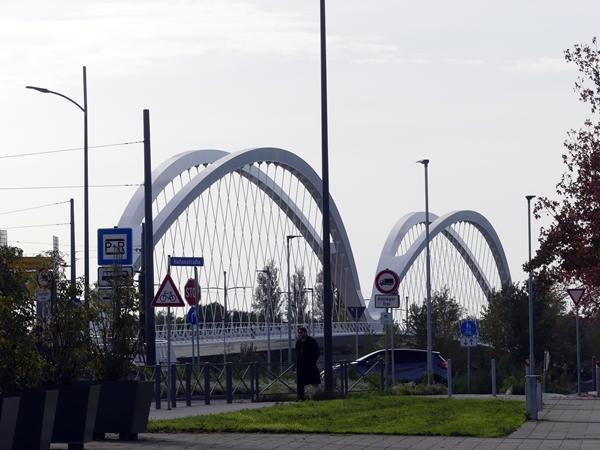
The aptly named “Pont de l’Europe” or “Europabrücke” between Strasbourg (France) and Kehl (Germany). This used to be a “proper” border with guards, and customs officers, and showing your passport. Then with the EU progressing, the controls became more lax and you only had to show your national ID document and often, you weren’t really checked at all.
Nowadays it’s just a bridge, there are no controls at all. Somewhere in the middle of the bridge is a sign denoting that you are entering from one country into the next. I would have liked to show that but it was impossible to take a photo in the totally jam-packed tram. Strasbourg and Kehl share a tramline (with announcements in both, French and German) and lots of people hop on in one country and get off in the other.
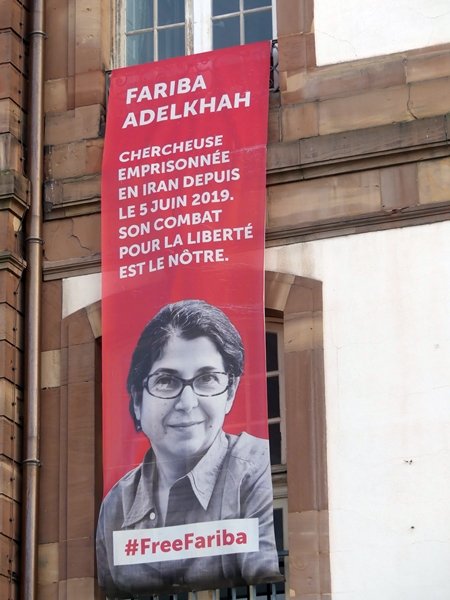
This banner is in support of Fariba Adelkhah who is currently detained in Iran. She lived in Strasbourg before she visited her native country of Iran and got arrested for spying and later convicted for conspiring against national security and for propaganda against the state. The banner is displayed on the front of the townhall of Strasbourg.



 pictures imperfect blog