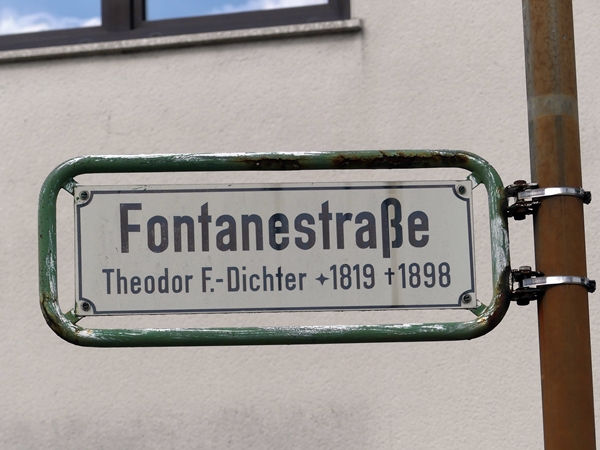
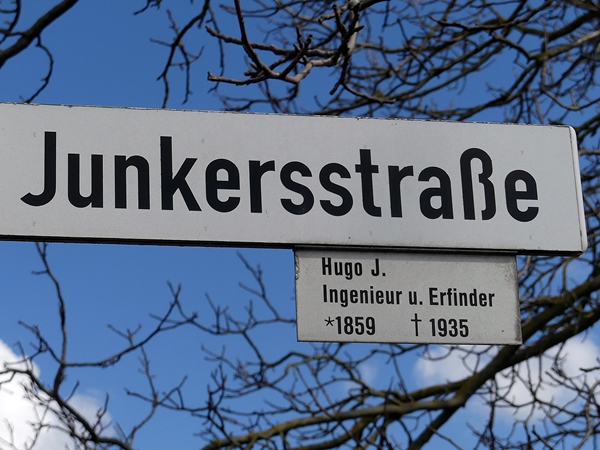
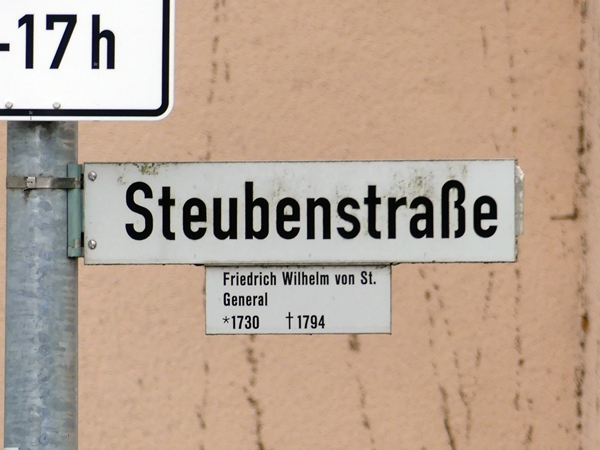


Some towns explain the choice of street names on the signs.
- Theodor Fontane was a German realist author, famous for his novels and poems.
- Hugo Junkers was an engineer and inventor, most famous for aircrafts.
- Friedrich Wilhelm von Steuben was a Prussian officer who became a pivotal figure in the American war of independence.
- Friedrich Wilhelm Murnau is a German expressionist film director of the silent era. His best known work is “Nosferatu”, an adaption of Bram Stoker’s “Dracula”.
- The Romans left their mark in our part of Germany – in our town some of the fields carried names dating back to them which are now town districts.
- Marcus Aurelius was a Roman emperor, also known as a Stoic philosopher.

I’ve shown the signs for this square in Frankfurt before. It has changed names often in its history and the signs document this:
- It was known as the “Jewish Market” from the 16th century onwards, it was the centre of Jewish life between the ghetto and the Jewish cemetery.
- In 1835 it was officially named “Börneplatz” after Carl Ludwig Börne, a journalist and satirist born in the Jewish ghetto of Frankfurt.
- 100 years later the Nazis found it unsuitable to have a square named after a Jewish writer and the square became the “Dominikanerplatz”, after the Domenican Order.
- Only in 1978 the city remembered the inglorious change of name and the square was once again the “Börneplatz”.
- The square was at the time an open, derelict place and town planning wanted to build administrative offices on the site. However, excavations discovered Jewish relics and for years there were discussions about what to do with space.
- In 1996 it was renamed as “The new Börneplatz” and became a memorial to Jewish life in Frankfurt.





 pictures imperfect blog