
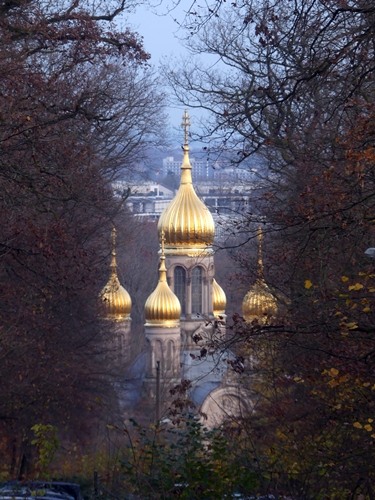
Once again, I started to look up the bare minimum of information to find a title for a Wordless Wednesday photo and I ended up learning so much that I just have to share:
This is the Russian-orthodox church St. Elisbeth’s on Wiesbaden’s Neroberg. It was built by Duke Adolf of Nassau who had married the niece of Tsar Nicholas I, Grand Duchess Elizabeth Mikhailovna of Russia in 1844. She died only a year later in childbirth together with their newborn daughter. Duke Adolf built this church around her final resting place as an expression of his grief. The church was used by a small Russian congregation which only got larger with the emigrées and refugees after the first World War. Today it serves an established Russian congregation.
The striking golden cupolas were last extensively cleaned and newly gilded when Vladimir Putin visited in 2007, costing half a million Euros.
 pictures imperfect blog
What an interesting – er, well – anachronism!
LikeLiked by 1 person
The church is in the middle of a forect (fairly large, all the same) and coming upon the view is always striking – best in sunshine but the cupolas gleam even in murky November weather.
LikeLiked by 1 person
And a congregation had half a million Euros?
LikeLike
I’m sure that they got a healthy dose of state money and/or Wiesbaden city money (seeing that Putin was visiting and all) and maybe some wealthy oligarchs also chipped in? When the church was built (i.e. 1850) Wiesbaden and the surrounding areas where “baths” and “spas” and rich Russians came “to take the waters”. Mabe the tradition lives on? – I tried to find out a bit and all I could find is that the congregation is struggling with the upkeep.
LikeLiked by 1 person
I’m sure it wouldn’t get polished for Putin these days 🙄
LikeLiked by 1 person
I better not comment. But Russian-Germans (late repatriates from Russia to Germany, i.e. Russians who claim to be of German heritage because of ethnic German grandparents who didn’t speak any German and came to Germany in the late 1980s and 1990s) sometimes have weird allegiances.
LikeLiked by 1 person
That looks stunning Elke.
LikeLiked by 1 person
I’m there once or maybe twice year, not often enough to get used to it. It always looks amazing.
LikeLike
Interesting. I’m into genealogy and I working on my brother-in-law, found that there are two US group dedicated to the history of Germans from Russia who emigrated to the US and Canada, mostly from what is now Ukraine starting in the late 1870s.
LikeLiked by 1 person
That sounds like an interesting field – in general. I’ve never been interested in my ancestors, going past my grandparents (but that goes back to the 1880s).
LikeLike
It is strange for a country like the US which supposedly is one of assimilation, but if someone is asked “what nationality area you?” the response is generally the country of origin of their ancestors. Even when it’s been several generations since emigration. I think the lack of old physical cultural connections may be part of it. For me, I’m just interested in history, my ancestors cultural origins, and stories records can tell. And we even borrow one or two people. 😀 There was a Napleonic general named Friederichs who was the second to the last name added to the Arc d’ Triomphe that we like to jokingly claims even though he is not related. But it’s a good story. Sorry for going on so long. Happy Friday.
LikeLiked by 1 person
Not at all. An interesting exchange. I always wondered why Americans are so obsessive with ancestry – just look at imdb (the movie database), often an actor is described as 1/3 Irish, 7/8 Mexican, … or something similar. I thought it had to do with lack of direct connections and lack of roots. Until I met people from Columbia. Also an immigration country. And the people have a medley of ancestors. But they simply cannot be bothered. – puzzling.
LikeLiked by 1 person
That’s a wow Elke
LikeLike
Thanks, Brian.
LikeLiked by 1 person
I agree. Though there is a difference in just being interested in one’s family tree and being very attached to the “old country” culture. I think that is common with later 19th century emigrants groups such as Italians, etc. On a different note, I am off to Columbia in Dec 5 if I can shake this bronchitis.
LikeLiked by 1 person
Enjoy Columbia! My friends are all wonderful people.
LikeLiked by 1 person