


Linked to the Cosmic Photo Challenge: Midsummer.
On Friday I rediscovered this giraffe (or possibly not) amongst my archived photos for the Friendly Friday Challenge.

It made me realise that I have more photos of giraffes. I’ve always liked these animals and it has upset me when I read that their conservation status has been moved from “least concern” to “vulnerable”.


No matter how difficult the task is, we will manage it!

Linked to I’m a fan of … #73. For more fanatical pictures, click here.
When I saw this large print ad, it spoke to me immediately

because

But joking aside, this is in my opinion the key to being truely happy:

It’s not easy to translate into an elegant aphorism, the best I can manage is:
Recognise happiness.
Linked to Friday Fun: A Saying.
As I’ve also been dabbling in lensball photography, I thought I slip them in here. I found it less exciting than what I thought it would be. For one thing, it’s a pain to carry it around and I’ve exhausted my backyard. It’s not easy to find a spot to put it and I don’t fancy my fingers in the shot. But for what it is worth:

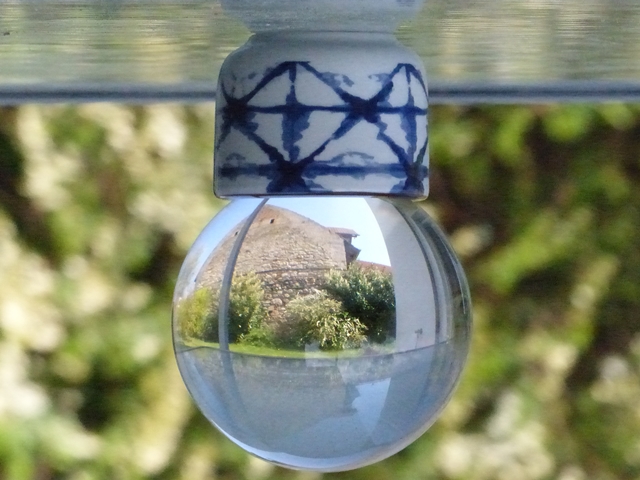
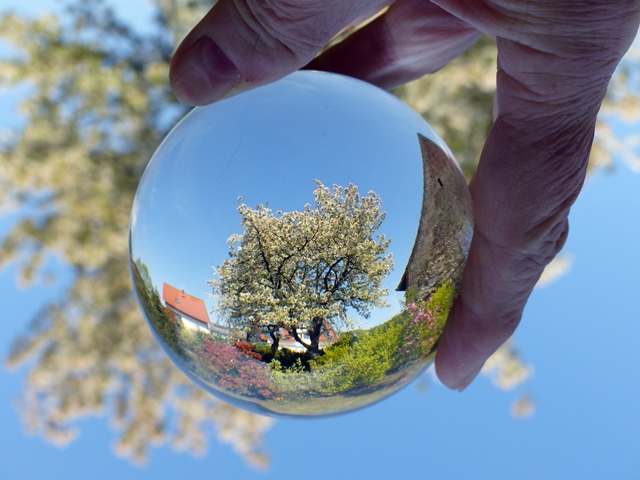
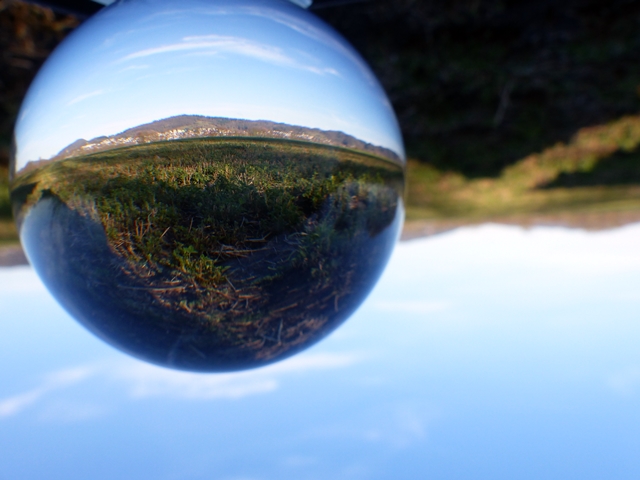
Linked to A Photo a Week: Anything.
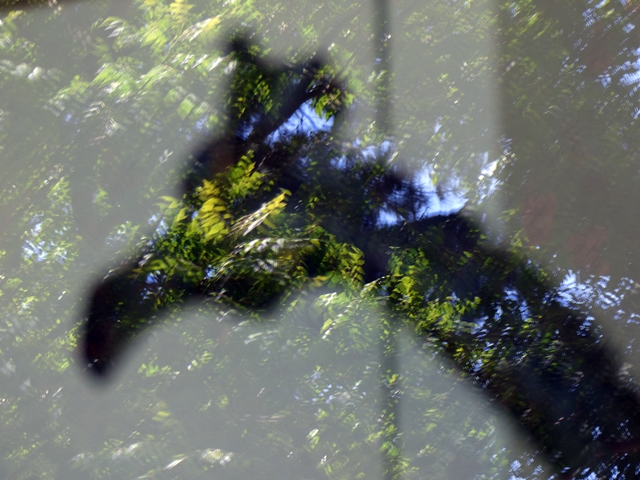
Deep in my archive there is this giraffe. I honestly don’t know anymore where it came from (it was taken before I started to properly organise all my photos, it’s my own fault). Maybe there was a giraffe lurking nearby creating this shadowy reflection on the window. Maybe it was something else. It was my most grievous fault not to notice.
There is something lurking in my memory archives. A French poem by Jacques Prévert.
Mea Culpa
C’est ma faute
C’est ma faute
C’est ma très grande faute d’orthographe
Voilà comment j’écris
Giraffe.
The poem relies on the fact that giraffe is spelled with only one f in French: girafe. So his fault was not actually a fault, just spelling in a different language. I have found translations neither in English nor in German, which is unusual because it is a well known poem and because of it outward simplicity and brevity often used in French language classes. The difficulty in translation is not only that “girafe” is “giraffe/Giraffe” in either language. Together with the fact that the poem is built on the Confiteor as used in the celebration of Roman Catholic mass and the Latin mea culpa is translated into French as c’est ma faute (it’s my fault) but in English it’s “through my fault” (because of the Latin ablative, the same problem occurs in German) and that makes a translation as a poem with the same depth impossible.
A literal translation would be:
Mea Culpa
It’s my fault
It’s my fault
It’s my most grievous orthographical fault
Here is how I wrote
Girafe.
Linked to Friendly Friday Challenge: Unusual.


Trains and trams have priority at this pedestrian crossing – a German traffic sign. I wish it were true for traffic policy as well. Less cars, more trains!
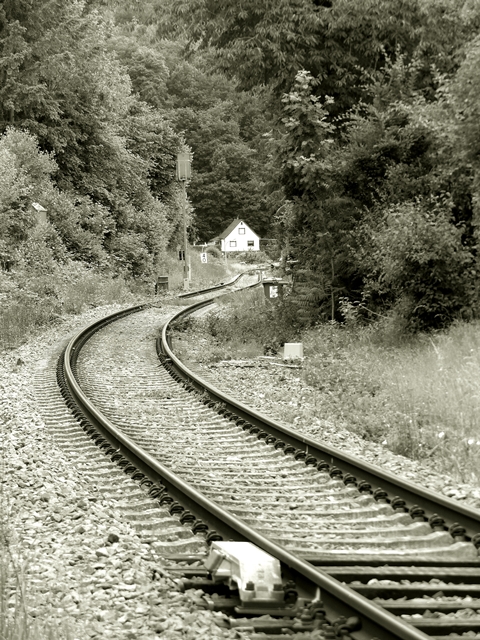
A quite nostalgic looking section of the Odenwald Bahn which curves through our backyard (literally, in my sister’s case).

This is the half-way station of the Heidelberg funicular railway which leads up to the hill called Königstuhl on the slopes of which the ruin of the Heidelberg castle is situated. It has been in operation since 1890 and has seen many modernisations throughout the years. In 1910 the upper section was added.
It’s difficult to see as there is dense woods on both sides. I should try to get there in winter next time!

Linked to Cee’s Black & White Photo Challenge: Trains and tracks.




 pictures imperfect blog