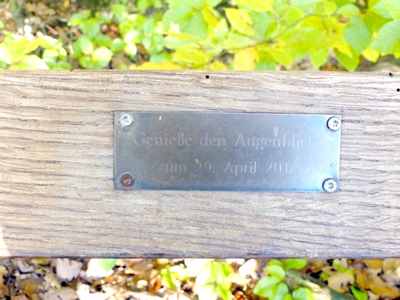
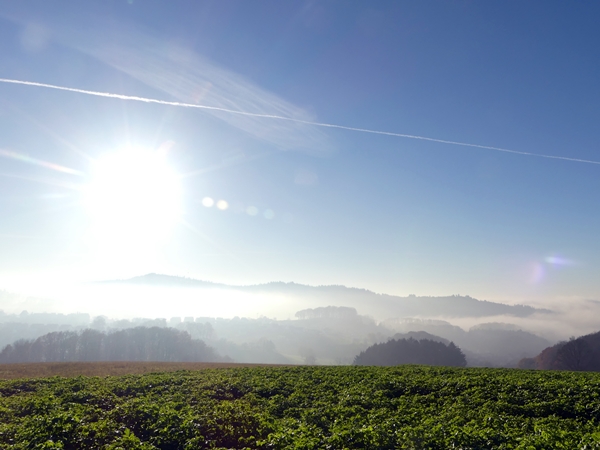
The sign on the bench tells hikers to enjoy the moment – and adds a date. I have no idea what the significance of that date is but I assume the people who sponosered the plaque know very well. But I’ve enjoyed a few moments … Continue reading Enjoy the moment
This is castle ruin Burg Hornberg above the town of Neckarzimmern. In Germany it is mostly famous for being the home of Götz von Berlichingen, the title hero of Goethe’s play. Not many people know the play but they know the name and his famous … Continue reading He Can Shove It!
With apologies to Johann Wolfgang von Goethe who wrote a well-known poem which starts: “Kennst du das Land, wo die Zitronen blühn?” (it’s normally translated as lemon trees but he writes lemons). If you are wondering, he was talking about Italy – not realising that … Continue reading Know You the Land Where Lemons Bloom?
Cover your heaven, Zeus,With cloudy vapours,And test your strength, like a boyBeheading thistles,On oaks and mountain peaks;Yet you must leaveMy earth alone,And my hut you did not build,And my hearth,Whose fireYou envy me. I know nothing more paltryBeneath the sun than you, gods!Meagrely you nourishYour … Continue reading Prometheus
The international running group of which I am part is known for its – let’s call it: creative – nicknames. A nickname has to be earned – you come to a few runs, you do something gloriously stupid, you are named. So when you first come to runs you are referred to as a “just”. Just + first name. Hence, these two would have been known as Just Johann and Just Friedrich if they had joined the HHH.
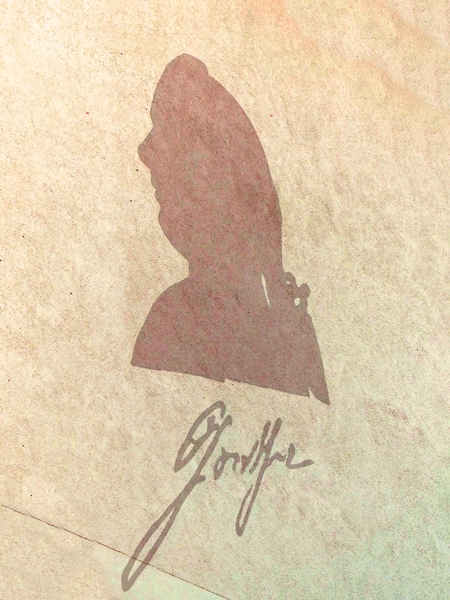
Last week, I admitted to being a fan of Friedrich Schiller, today I want to show off the other half of the German poetic pair, Johann Wolfgang von Goethe.
He was a very prolific writer – he lived a long life and wrote defining works during quite a few of the literary epochs he lived through, from the Sturm und Drang (the rebellious pro-romantic youth movement), through the classic era to post-romanticism. He was also a natural scientist of renown. He studied law and worked as a minister at the court in Weimar. His literary works comprise poems, novels, essays and plays – he wrote THE definitive German play, Faust (part I and II – of which I still know parts by heart).
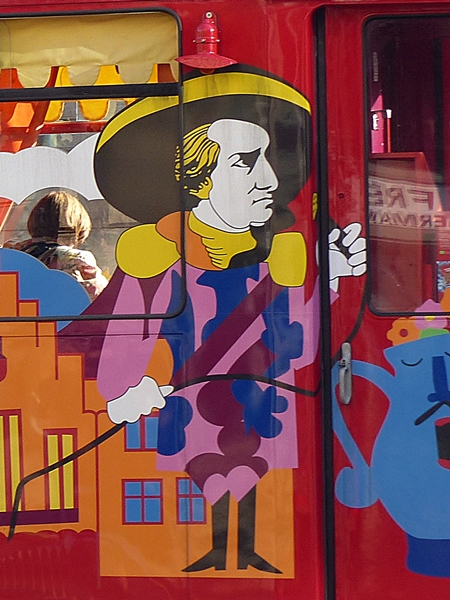
He was born in Frankfurt am Main and so it is no surprise that his face is seen in lots of places in the state of Hesse and in Frankfurt in particular.
The middle picture is not from Frankfurt but I found it in Teplice in the Czech Republic.
Werther
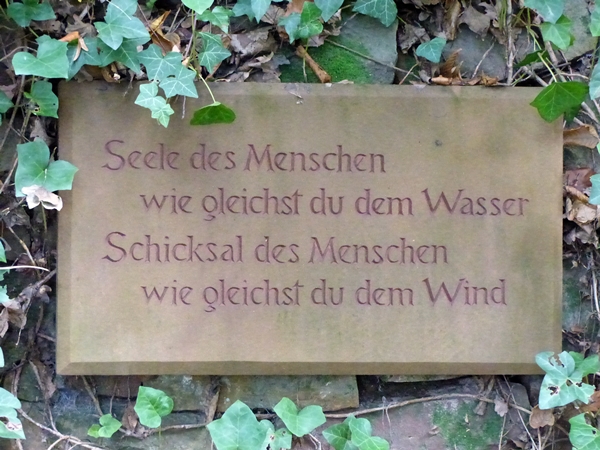
The plaque is a quote from the poem “Song of the Spirits over the Waters” and is translated as:
“Soul of man, how like to the water! Fate of man, how like to the wind!”
The mural is a quote from the novel “The Sorrows of Young Werther” and the translation reads:
“Death, where is your sting? Love, where is your victory?”
And finally a photo of the sculpture in front of the Hessisches Landesmuseum in Wiesbaden, which I found really very weird. Just look at the face of a middle-aged Goethe on top of the body a much younger man who spends his time in the gym rather than be the bon vivant which Goethe was according to all that we know.
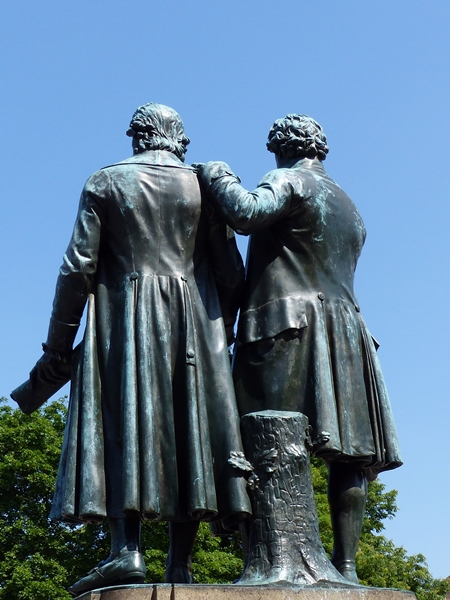
I’d rather end this post with another view of the Goethe and Schiller, the two friends.
In the first scenes of what is arguably the most well-known German play, Faust has contemplated suicide because he has realised his limitations in the light of his ambitions. The ringing of the church bells at the break of dawn and the Christian message of the risen Christ hold him back.
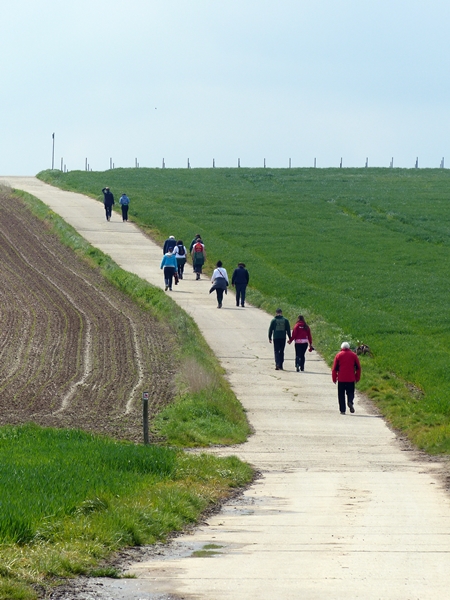
Next morning he leaves the city to join the masses of people on a stroll outside the city gates. The following is an ode to spring and humanity, a piece of poetry colloquially known as the “Easter Walk” and lines from it are known by almost every German. He starts with describing the surroundings, seeing nature freed from the white ice just as the people are freed from the grey city. Nature is still lacking colour this early in spring, so people have to supply it with their finery. The soliloquy ends with Faust’s awareness that he can join the rest of humanity.
Hence, the photo of an Easter Sunday morning stroll.
“In nature we never see anything isolated, but everything in connection with something else which is before it, beside it, under it and over it.”
Johann Wolfgang von Goethe
“Wir sehen in der Natur nie etwas als Einzelheit, sondern wir sehen alles in Verbindung mit etwas anderem, das vor ihm, neben ihm, hinter ihm, unter ihm und über ihm sich befindet.”
Linked to Travel with Intent. For more photos inspired by this quote from Johann Wolfgang von Goethe, click here.
These six words need an explanation. I had a quote from Goethe’s Faust in mind (one great poet versus another one, answering Debbie’s Shakespeare) when I compiled these photos and was looking for the standard translation into English. I entered a few keywords in the search mask including the name Faust and English and was rewarded with the above gem of the google translator.
Goethe: Faust I
If ever I to the moment shall say:
Beautiful moment, do not pass away!
Werd ich zum Augenblicke sagen:
Verweile doch! du bist so schön!
The rest of the quotation is actually a denial of the perfect moment, or rather the striving for an ever more perfect one – so I’ll just ignore it for the purpose of this post.