
We have gotten used to spelling mistakes on the internet. I’m old so I remember when texts were still edited and corrected and such errors being an exception. But spelling errors on posters, graffiti and the like have a longer life span than internet posts.
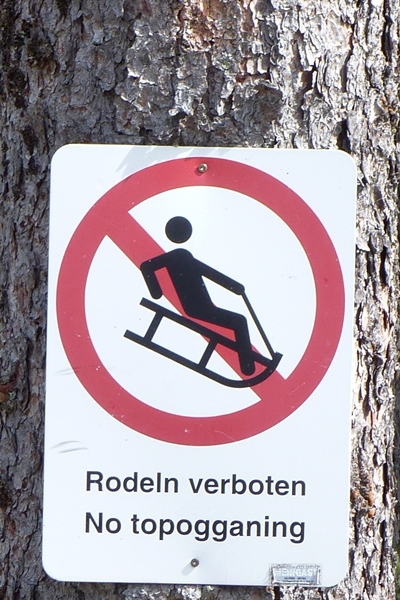
I’ll start with an English one that doesn’t need much of an explanation. It’s a bit unfair because it was writting by a non-English speaker but even internet translators let alone printed dictionaries could have helped.

This particular one rubs me the wrong way because it involves my last name. It’s a wrong spelling in the German word “Wollknäuel” (ball of yarn). With some benevolence I might concede that it’s due to an attempt to be original but it is just … not right.
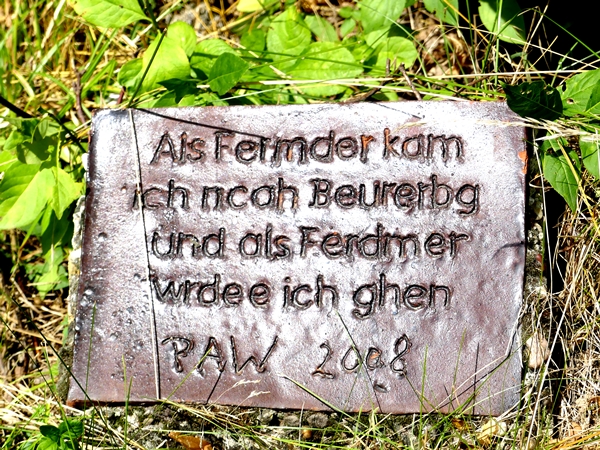
Here the letters are scrambled in many of the words (Fremder – nach – Breuberg – Fremder – werde – gehen). As it is an attempt at art to show somebody (a stranger) not fitting in it’s very probably deliberate. It’s set in … not stone but in clay.
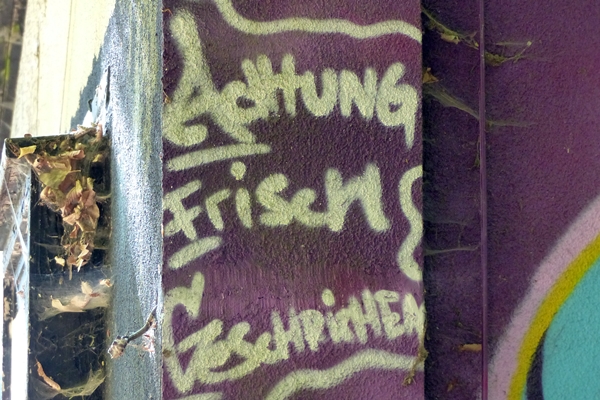
Graffiti is more fleeting. The words “frisch gestrichen” are misspellt, again probably deliberately. The unsophisticated way that whole wall looks like though, it might be a genuine – lasting – mistake.
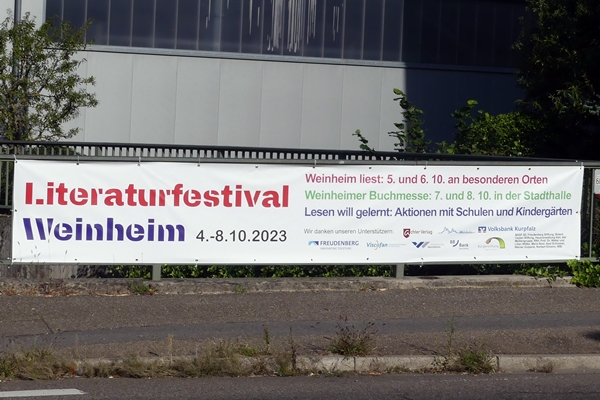
Not a spelling error but a grammatical one. In the line: “Lesen will gelernt” (reading has to learned). There is the problem of space in that line but for crying out loud, the poster advertises a festival of LITERATURE aimed at school children! Even if it was deliberate (I doubt it) it would be a blunder.

……………………………………….
 pictures imperfect blog
I can’t believe how often these blunders occur. How hard is it to use a dictionary/find a native speaker/check online?
LikeLiked by 2 people
Quite. A few years back they started a permanent dinosaur installation in a park in Kaiserslautern, with German and English information. The mistakes aren’t glaring but the inscriptions were obviously written by Germans, they were at best clumsy. NB: There are about 50.000 US American soldiers stationed in the vicinity, not to mention the auxillary employees and the families of all of them. They couldn’t find one of them?!
LikeLiked by 2 people
ExACTly.
LikeLiked by 1 person
You must have a difficult time walking around seeing stuff like this
LikeLiked by 2 people
Life is hard. 😣 What is even harder is to keep quiet about it (most of the time) because I want to be neither a typical German nor a typical Karen.
LikeLiked by 2 people
I have to bite my tongue a bit as well, we won’t go anywhere near apostrophes 🙄 😂
LikeLiked by 1 person
Are you sure that you don’t speak German? Apostrophes are the bane of German grammar critiques. If you use apostrophes as in English it’s called an idiot apostrophe (because it’s wrong in German) but as a result people get it completely wrong.
LikeLiked by 1 person
😂
LikeLiked by 1 person
Ja, das ist heutzutage leider sehr oft so, Grammatikfehler, Rechtschreibfehler, Übersetzungsfehler, auf Deutsch, auf Englisch, auch auf Arabisch, vor allem im Internet, auch auf Schildern.Was noch schlimmer ist, die meisten akzeptieren keine Kritik, und nehmen es persönlich.
LikeLiked by 1 person
Stimmt. Und es wird automatisch schlimmer. Weil man früher fast nur richtiges gesehen hat, war man weniger verwirrt. Ein Beispiel ist der “Standart” (!), das sieht man gefühlt mindestens 50% falsch geschrieben.
LikeLiked by 1 person
Auch in der Schule wurden Rechtschreibfehler und Grammatikfehler früher viel strenger benotet. Man hat fast nur Richtiges gesehen, wie du sagst .
LikeLiked by 1 person
Das ist der weltweite Trend, auch im arabischsprachigen Raum.
LikeLiked by 1 person